
Blog
Who are the Stoic Founders: Zeno of Citium + his best quotes
Mar
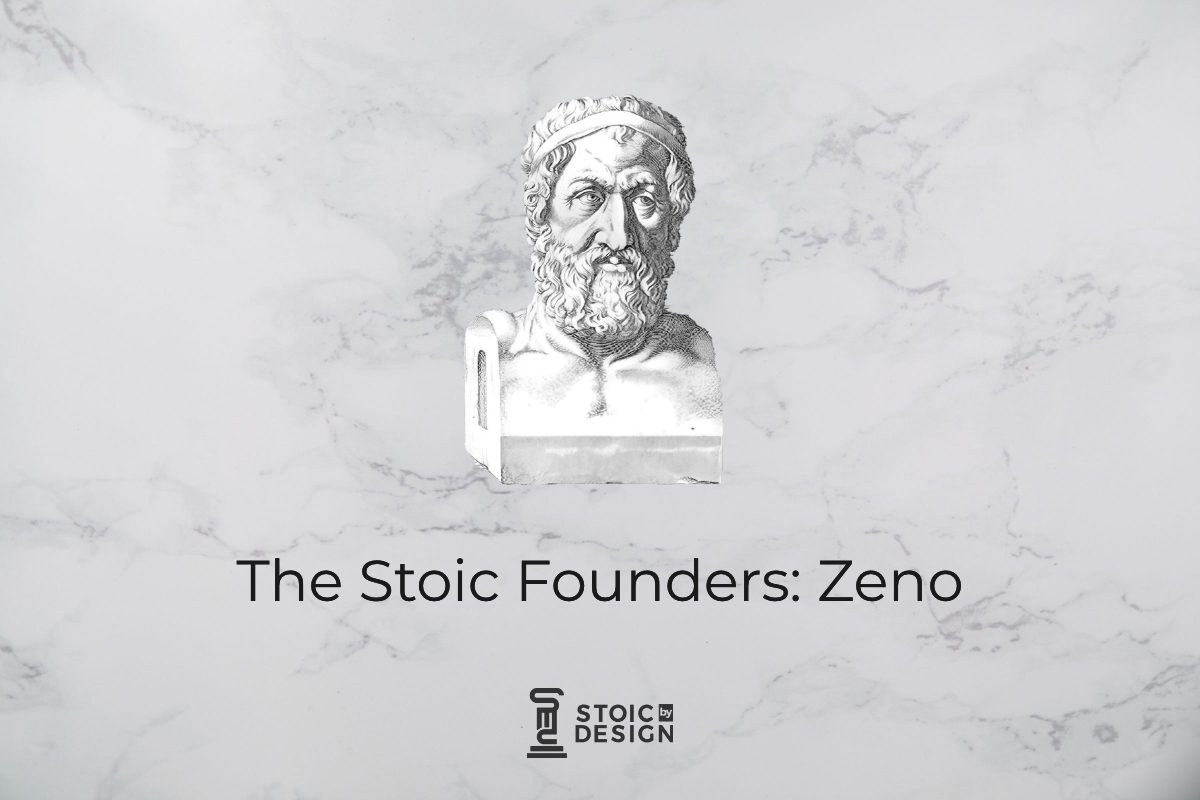
Zeno was the founder of Stoicism which he taught in Athens from 300 BC.
He was born in 333 BC in the town of Citium, a Greek colony with a large Phoenician population. For most of his youth, he was a merchant. The story has it that during a voyage between Phoenicia and Piraeus, Zeno survived a shipwreck. He ended up in Athens and was introduced to the philosophy of Socrates and his contemporaries while browsing a bookstore. He started looking for philosophers and became the pupil of Crates the Cynic. It led him to develop the principles and thinking that we now know as stoicism.
He began teaching in the Agora of Athens known as the Stoa Poikile. Initially, his disciples were known as Zenonians, but they later came to be known as Stoics. The core message of this philosophy in his own words is that “Happiness is a good flow of life”. The only way to achieve it is to live a life of virtue in accordance with reason and nature. Our role was to accept and live according to nature. We should accept our destinies unquestionably since they embody the will of the universe.
Zeno preached that “man conquers the world by conquering himself”. He argued that by controlling our emotions and physical desires, we could develop wisdom and the ability to apply it. He encouraged the practice of meditation to develop an indifference to both pain and pleasure.
After his death, the Athenians built a bronze statue in honour of Zeno and passed the following decree extolling a man that was a real example to look up to:
“Whereas Zeno of Citium, son of Mnaseas, has for many years been devoted to philosophy in the city and has continued to be a man of worth in all other respects, exhorting to virtue and temperance those of the youth who come to him to be taught, directing them to what is best, affording to all in his own conduct a pattern for imitation in perfect consistency with his teaching, it has seemed good to the people—and may it turn out well—to bestow praise upon Zeno of Citium, the son of Mnaseas, and to crown him with a golden crown according to the law, for his goodness and temperance, and to build him a tomb in the Ceramicus at the public cost….”
None of Zeno’s writings has survived except as fragmented quotes preserved by later writers. The best account of him that we have is by Diogenes Laertius, the biographer of Greek philosophers. However, we do know some titles from Zeno’s works, including Republic, a work he wrote in direct opposition to Plato’s Republic. He used it to outline the ideal society based on egalitarian principles.
As Plutarch wrote of Republic, it “aims singly at this, that neither in cities nor in towns we should live under laws distinct one from another, but that we should look upon all people, in general, to be our fellow-countryfolk and citizens, observing one manner of living and one kind of order, like a flock feeding together with equal right in one common pasture.”
Zeno Quotes
“We have two ears and one mouth, so we should listen more than we say.”
― Zeno of Citium, as quoted by Diogenes Laërtius“Man conquers the world by conquering himself.”
― Zeno of Citium“The goal of life is living in agreement with Nature.”
― Zeno“if being is many, it must be both like and unlike, and this is impossible, for neither can the like be unlike, nor the unlike like”
― Zeno“The reason why we have two ears and only one mouth is that we may listen the more and talk the less.”
― Zeno“Well-being is attained little by little, and nevertheless is no little thing itself.”
― Zeno of Citium“We have two ears and one mouth, therefore we should listen twice as much as we speak.”
― Zeno“When a dog is tied to a cart, if it wants to follow, it is pulled and follows, making its spontaneous act coincide with necessity. But if the dog does not follow, it will be compelled in any case. So it is with men too: even if they don’t want to, they will be compelled to follow what is destined.”
― Zeno of Citium
