
Blog
Who are the Stoic Founders: Cleanthes + his best quotes
Mar
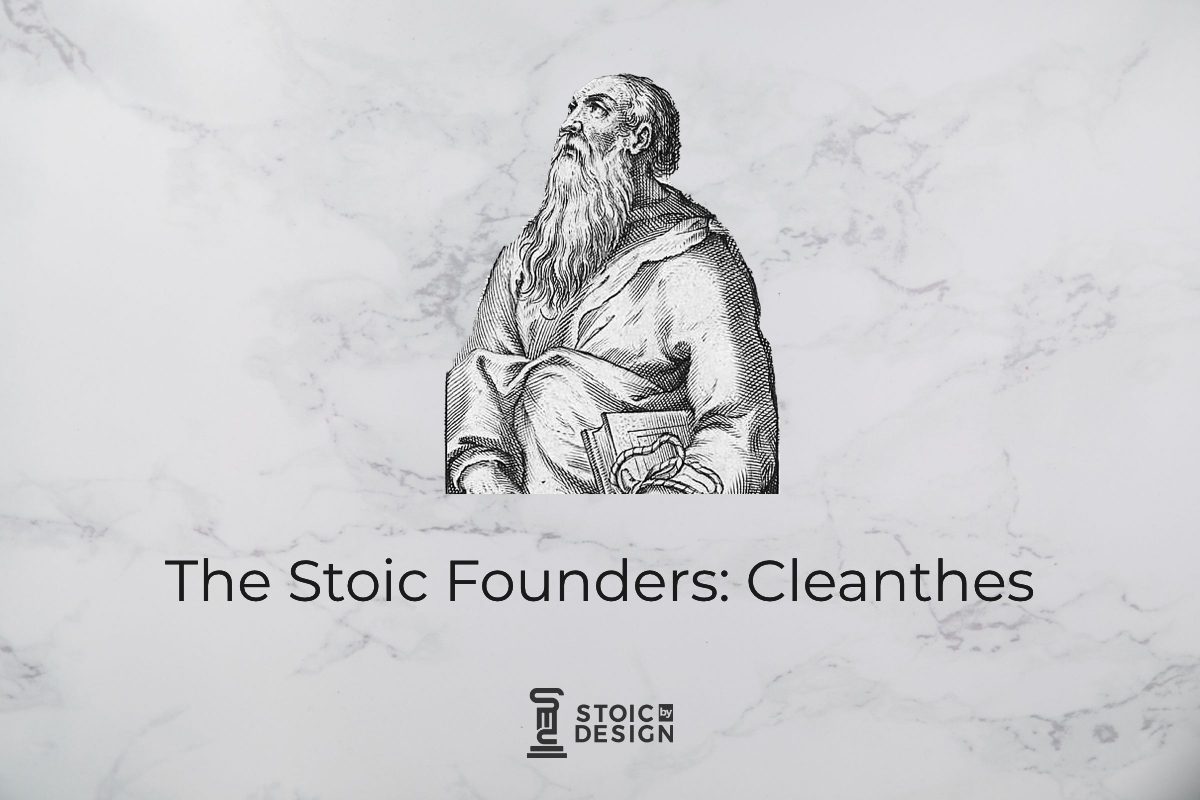
Who Is Cleanthes? The successor to Zeno & Second Head of the Stoic School
Famous writers such as Kafka and Bukowski were known to live a dual life: they held a comfortable and dull job during the day and spent the rest of the time writing. Kafka was working at an insurance company while Bukowski worked at the post office. Those desk jobs required little mental stimulation which allowed them to entirely focus on their creative output the rest of the time. An ancient example of dual lifestyle was Cleanthes who succeeded Zeno as the founder of Stoicism.
To support his pursuit of wisdom and his philosophical studies, Cleanthes would work as a water carrier at night to which he was even summoned to court. Indeed, the court wondered how a man could spend his entire day studying philosophy. Cleanthes managed to prove his hard work during the night, and the court was so impressed that they even offered him money, but Zeno made him refuse it.
So who was this industrious philosopher? Cleanthes of Assos (c. 330 BC – c. 230 BC) was a boxer when he arrived in Athens. According to Diogenes Laërtius, Cleanthes came with little money and began attending Crates the Cynic’s lectures and later on Zeno’s lectures. He then became the successor of Zeno as the head of a Stoic school, a position he held for 32 years. His pupil, Chrysippus, later became one of the most essential Stoic thinkers.
Reading about Cleanthes one finds a curious lesson relayed by Diogenes Laërtius: “When someone inquired of him what lesson he ought to give his son, Cleanthes in reply quoted words from the Electra: Silence, silence, light be thy step.” And as a Stoic, he also held that living according to nature is living virtuously.
Cleanthes passed away at the age of 99 in Athens and the philosopher Simplicius, writing in the 6th century AD, says that a statue of Cleanthes was still visible at Assos.
Just like Zeno, there is a very little of Cleanthes’s work in circulation. He has written books on interpretations of Zeno, on the philosophy of Heraclitus as well as works on myths and poetry. The best source on Cleanthes that we have, just like with Zeno, is Diogenes Laërtius in his Lives of the Eminent Philosophers.
Cleanthes quotes
Lead me on, O Zeus, and thou Destiny,
To that goal long ago to me assigned.
I’ll follow readily but if my will prove weak;
Wretched as I am, I must follow still.
Fate guides the willing, but drags the unwilling.
Cleanthes
“Conduct me, Jove, and you, O Destiny, / Wherever your decrees have fixed my station.”
Cleanthes
“The Fates guide the person who accepts them and hinder the person who resists them.”
Cleanthes
